
Why is charred wood a good choice for a house facade?
- 25/10/2026
A house facade has two jobs: to protect the building's structure from the elements and to shape its architectural character. That is why it's important to choose a cladding material that is not only attractive but also suitable for long-term outdoor use. One such solution is charred wood cladding.
Controlled charring of the wood surface brings out its natural texture and creates a carbonised layer. Depending on the finish chosen, the wood can then be brushed and oiled. This makes it possible to achieve very different results – from natural brown and greyish tones to deep graphite or black. However, choosing charred wood for a facade is about more than just looks.
What is charred wood?
Charred wood is natural timber whose surface has been exposed to flame in a controlled way. The technique is associated with the Japanese Yakisugi method, often called Shou Sugi Ban in the West.
Charring primarily changes the outer layer of the wood. The surface is carbonised, and further processing depends on the desired result. The heavily charred surface can be kept, or it can be brushed to open up the grain and create a more textured relief. Boards intended for exterior cladding are often oiled as well.
Medeksa produces charred facade cladding from selected timber that is charred, brushed and oiled. We offer both charred spruce and larch cladding boards in a range of shades.
Table of contents
1. Oiled surface protects against moisture
Facade timber is exposed to rain, snow and changing humidity, so the final surface treatment of the cladding boards matters. After charring and brushing, Medeksa cladding boards are finished with oil. It is primarily the oil, not the charring itself, that helps reduce water absorption through the treated surface. Charring and brushing shape the texture of the wood, while oiling adds protection against direct exposure to moisture.
The properties of an oiled surface depend on the product used, the quality of application and the condition of the finish. That is why the surface should be inspected periodically and re-oiled when needed, following the oil manufacturer’s recommendations.
That said, oiling does not make wood completely waterproof and is no substitute for proper facade installation. Air must be able to circulate behind the boards, and structural joints must be detailed so that water can drain away and the wood can dry out.
2. Wood durability and prevention of biological damage
Surface charring alone is not enough to consider wood protected against fungi or pests. Such claims would require data confirming the resistance of a specific product. That is why, when assessing whether charred wood is suitable for a facade, it is important to consider the wood species, its preparation, installation conditions and maintenance.
To reduce the risk of fungal damage, moisture must not be allowed to linger in the wood. A ventilated gap behind the cladding, proper water drainage and avoiding areas where moisture collects all help the facade dry out.
Surface oiling is one maintenance measure, but it should not be equated with protection against fungi or insects unless the manufacturer of the specific product states such properties. A long-lasting facade is built on a combination of properly prepared timber, well-thought-out installation and consistent maintenance.
3. A distinctive look that doesn't hide the wood grain
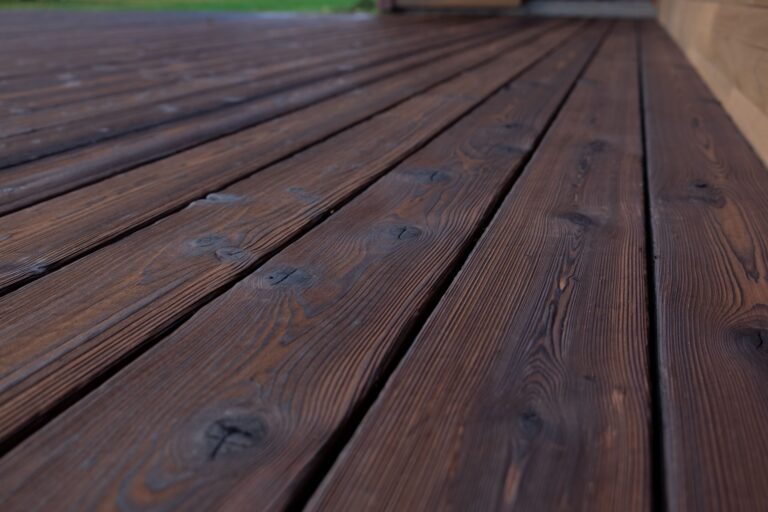
One of the main reasons why charred wood facades have become popular in contemporary architecture is their appearance. Charring does not hide the wood grain – on the contrary, it can make it even more pronounced.
Every board has its own individual grain pattern, so even a single-colour facade is never completely monotonous. The surface keeps the character of a natural material while looking very modern.
Charred wood is not only black. Depending on the charring intensity, brushing, wood species and oil used, it can take on graphite, brown, sand, greyish or almost black tones. For facades we offer various charred spruce and larch options, including Black, Graphite, Rust, Sand, Terra and other shades.
4. Charred wood pairs easily with other facade materials
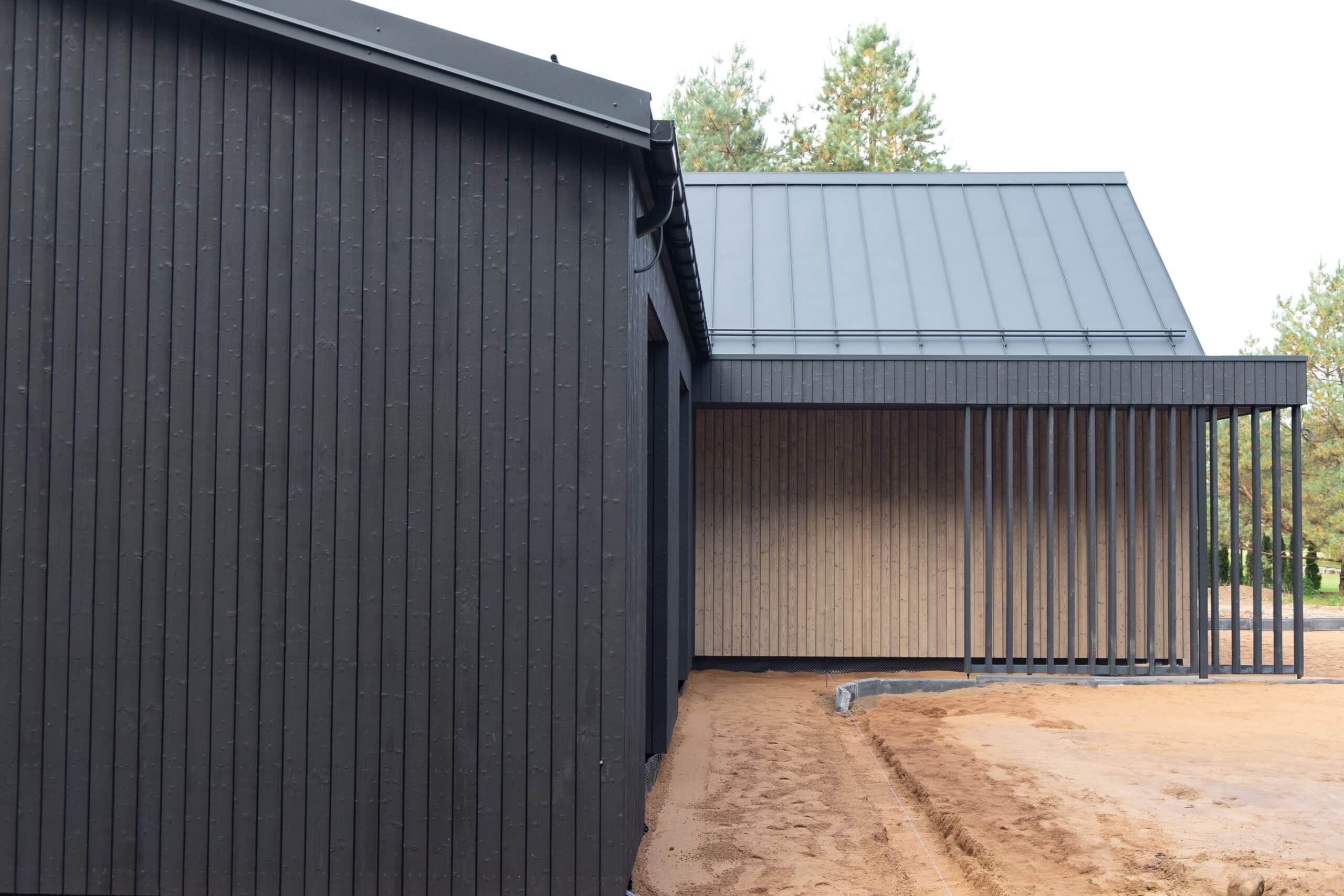
A charred wood facade doesn’t mean the whole building has to be clad in timber. It also works well as an accent finish.
Charred wood can be combined with render, concrete, glass, metal, brick, natural stone or slate. Darker boards can highlight an entrance, a terrace wall or a separate volume of the building, while lighter brown and sand tones create a more understated facade.
| Architectural solution | What does charred wood add? |
|---|---|
| Entire façade | A unified, striking character for the building |
| Entrance area | Highlights the main entrance and gives it visual depth |
| Terrace wall | Naturally connects the house façade with the outdoor space |
| Building extension | Helps visually separate different volumes of the building |
| Combined with render | Wood softens smooth rendered surfaces |
| Combined with concrete or metal | Creates a contrast between natural and industrial materials |
Thanks to this versatility, charred wood is used both in modern minimalist houses and in Scandinavian or more nature-inspired architectural projects.
5. The facade doesn't need repainting every year

A painted wood surface may start to fade, crack or peel over time. The old coating then has to be prepared and renewed.
Charred wood is maintained differently. A brushed and oiled surface can be periodically refreshed with oil, but it should not be treated like a painted surface that must be regularly recoated with a thick new layer.
For facades and fences, Medeksa recommends re-oiling the surface approximately every 5–7 years, but the actual interval depends on the facade orientation, sun exposure, precipitation, the chosen colour and other conditions of use. Lighter tones may need maintenance more often.
So the claim that “charred wood needs no maintenance” should not be taken literally. It is a low-maintenance facade material, but periodic inspection and surface renewal help preserve the desired colour and appearance for longer.
6. You can choose between different wood species
The final properties of a facade are determined by more than just charring. Equally important is which wood is charred.
Spruce or larch are the most common choices for facades. These woods differ in density, mechanical properties, texture, price and natural durability.
Spruce can be a cost-effective choice for larger facade areas, while larch is chosen when higher density, natural durability and a more pronounced texture matter. Medeksa produces charred cladding boards in both species for facades.
| Property | Charred spruce | Charred larch |
|---|---|---|
| Surface character | More subtle, more even | More pronounced and textured |
| Wood density | Lower | Higher |
| Mechanical resistance | Softer | Stronger |
| Natural moisture resistance | Lower | Higher |
| Price | Usually more economical | Usually higher |
| Where is it suitable? | Large façade areas where price and uniformity matter | Projects that call for stronger, more expressive wood |
7. Board direction and profile change the character of the facade
The look of a charred wood facade depends on more than colour. The installation direction, width and profile of the boards also play a big role.
Vertically installed boards make a building look taller and create a strong rhythm of vertical lines. In this direction, water also runs off the board surface easily.
Horizontal installation visually stretches the building in width and suits a calmer, more traditional facade composition.
The profile also changes the final look. Some boards form an almost continuous surface, while others leave clearer gaps and create a pronounced rhythm of shadows and lines. That is why the facade profile is best chosen at the design stage, not after the timber has already been ordered.
8. Natural ageing can be part of the facade design
Wood is a living, natural material, so its surface changes over time. Even charred and oiled wood is exposed to UV radiation, precipitation and temperature fluctuations.
If you want to keep the original shade for as long as possible, use dedicated protective oils and renew them periodically. If a change in colour is acceptable, the facade can be allowed to age more naturally.
The orientation of the building should also be considered at the design stage. South- and west-facing facades usually get more sun than north-facing ones, so different walls may age at different rates. Oils with UV protection help reduce this difference.
Charred wood – for a long-lasting, distinctive facade
Charred wood cladding combines the aesthetics of a natural material, a surface that withstands environmental exposure and wide design possibilities. However, the final result depends on more than charring – the wood species, its preparation, oiling, board profile, proper installation and subsequent maintenance all matter.
Medeksa produces charred spruce and larch cladding boards, so the facade solution can be chosen to suit the building’s architecture, the desired colour, texture and conditions of use. Properly selected and installed, charred wood can become not only a protective finish for your home but also one of its most striking architectural features.
Share:
Frequently asked questions
The fact that wood has been charred does not mean any board will be suitable for a long-lasting facade. When comparing offers, it is worth finding out the wood species, its moisture content, the charring technology, whether the surface is brushed, what oil is used and whether the chosen profile suits the specific installation method.
The facade installation itself is just as important. Even high-quality timber can quickly cause problems if no ventilation gap is left, corners and drainage points are poorly detailed, or fasteners unsuitable for outdoor conditions are used.
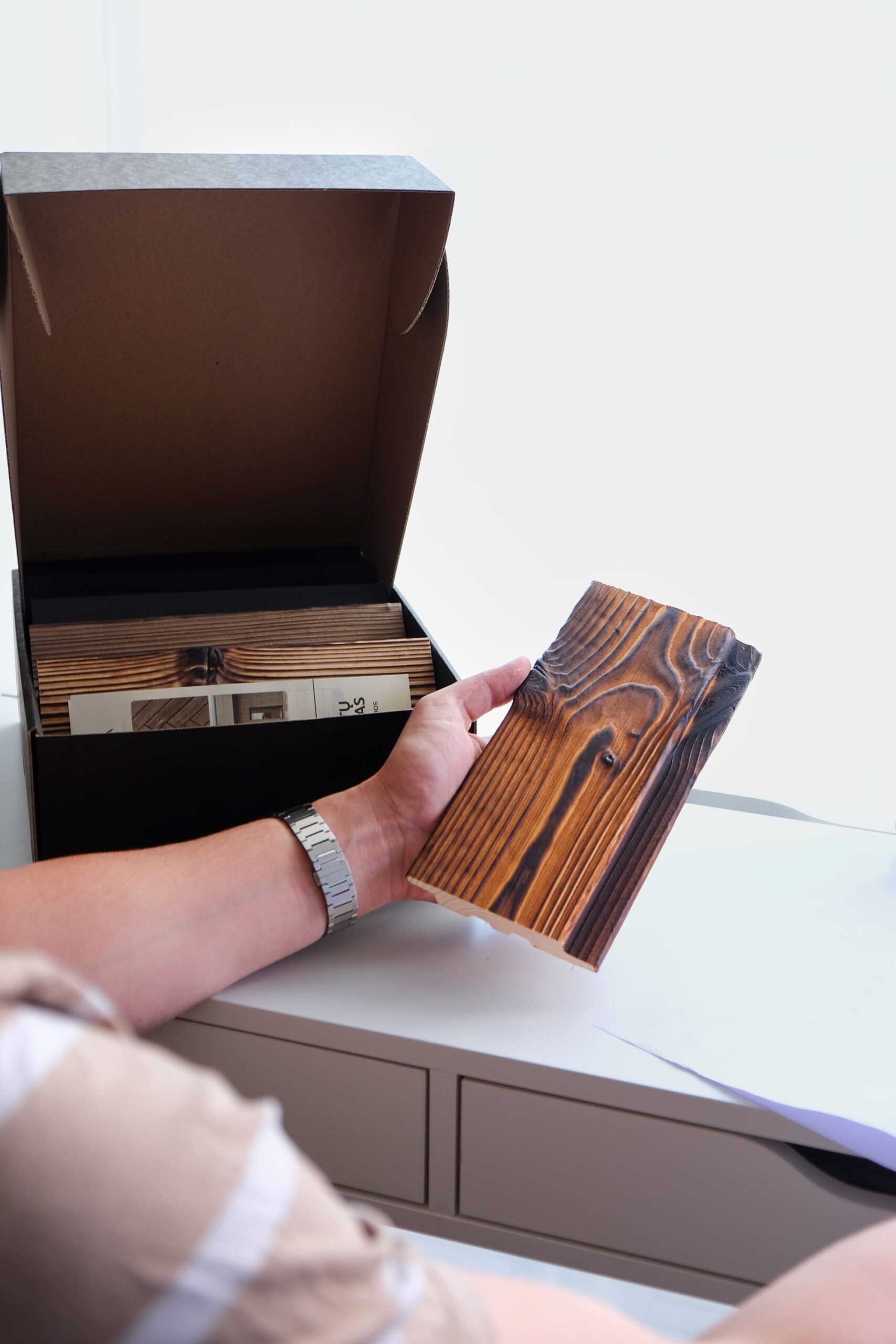
Before ordering a whole facade, it is worth seeing real wood samples. Colours on screen do not always accurately reflect the shade of the wood, and different lighting strongly changes how dark, textured surfaces are perceived.
Complex maintenance work is usually not needed every year, but the facade should be inspected regularly. Any accumulated dirt can be removed gently without damaging the surface. Aggressive chemical cleaners or heavy mechanical scrubbing are not a good choice, especially if you want to preserve the textured surface of the charred wood.
The condition of the oil should also be assessed periodically. How often it needs renewing depends on the facade's location and the desired look – a wall in the shade may change much more slowly than a south-facing side of the house exposed to direct sun all day.
The key principle of durability remains very simple: the wood must be able to dry out. A well-designed ventilated facade and properly detailed drainage points are just as important to the service life of the wood as the charring itself.
Charred wood is worth considering when you want a natural material but also a more striking and durable surface than completely untreated boards. It is well suited to contemporary private houses, summer houses, country homes, saunas and other buildings where the facade is an important part of the overall architecture.
Combinations of different wood species, charring intensity, colour and profile offer especially wide possibilities. As a result, a charred wood facade can be either understated or very bold – from a soft natural wood surface to a deep black facade.
Medeksa produces charred spruce and larch cladding boards for facades, and the range of surfaces and shades allows the solution to be tailored to a specific building's architecture. When choosing, consider not only the colour but also the wood species, board profile, installation direction and future conditions of use – it is the combination of these elements that determines how the facade will look and perform in the long term.
This is an important question, because the term "charred wood" is sometimes mistakenly understood as "non-combustible wood".
Carbonising the surface changes the outer layer of the wood, but charred wood cannot automatically be considered a non-combustible or fire-resistant facade material. A specific product's reaction to fire depends on the wood species, profile, thickness, treatment, construction and the tests carried out on that particular product.
Therefore, for buildings subject to specific fire safety requirements, follow the project design solutions and the technical documentation of the chosen facade product, rather than relying solely on the fact that the wood surface has been charred.
More about charred wood
The beauty of charred wood is in the details. See and feel them for yourself.