
Which wood should you choose for a terrace?
- 22/11/2026
Terrace location and conditions of use
Before choosing boards, consider how much sun the terrace will get, whether rain and snow will fall directly on it and how quickly the surface will be able to dry. In a damp garden surrounded by trees, the key issues will be water drainage and cleanliness. In an open, sunny spot, more attention will have to go to changes in surface colour and maintenance of the finish.
How the terrace will be used matters just as much. In a lounge area where people often walk barefoot, surface smoothness and the risk of splinters are what count. In a dining area you will need to consider chairs being pushed around, food stains and whether the surface can be wiped clean without damaging the finish.
| Terrace conditions | Key selection criterion | What to plan in advance |
|---|---|---|
| Open terrace without a roof | Suitability of the wood for frequent wetting and drying | Water drainage, ventilation and surface maintenance |
| Terrace under trees | Ease of removing leaves and dirt | Easy cleaning and gaps between boards that do not clog |
| Sunny terrace | Acceptable colour change and finish renewal | The desired shade and the maintenance needed to preserve it |
| Heavily used dining area | Resistance to dents and surface wear | Furniture leg protectors and suitable cleaning products |
| Covered lounge terrace | Surface quality and comfort underfoot | Board texture, edge finishing and fastening method |
Even a covered terrace can be reached by wind-driven rain or snow. A roof therefore reduces direct exposure to the elements, but it does not make the conditions on an outdoor terrace the same as indoors.
Contents
The most important properties of decking wood
Resistance to rot, dimensional stability and surface hardness are different properties. Resistance to rot describes the ability of wood to withstand biological decay. Dimensional stability shows how much it swells and shrinks as moisture levels change. Hardness matters when assessing dents that furniture or other mechanical impact may leave.
These properties should not be lumped into a single promise of “durability”. For example, a more stable board will not necessarily be harder, and denser wood is no substitute for proper water drainage. In practice, a good result comes from the combination of the wood’s properties, its treatment and its installation.
The main wood options for a terrace
The wood species and the way it is treated are not the same thing. Pine, spruce and larch refer to the raw material, while impregnation, thermal modification or charring describe how it has been prepared for use. When buying, you should therefore find out not only what the boards are called, but also how they have been treated and what they are intended for.
Impregnated pine
Impregnated pine is often chosen when planning a more economical wooden terrace. However, you should look beyond the price or the shade of the boards to the conditions of use the wood has been prepared for. Simply coating the surface with a protective product is not the same as industrial pressure impregnation.
Impregnation does not turn pine into a hard material or one that does not react to moisture at all. The boards can still swell and shrink, and furniture legs or other pressure may leave marks on the surface. This option is suitable when budget matters and the natural changes of a softer wood are acceptable.
Larch boards
Larch is valued for its expressive grain and denser wood. Its surface is harder than that of spruce, but this does not mean it will not scratch or that the boards will need no maintenance.
When choosing larch, board selection is important. It is worth assessing the condition of the knots, cracks, straightness and how much heartwood and sapwood the board contains. These parts of the wood differ in their natural resistance to biological decay, so the species name alone does not describe the overall quality of the product.
Larch suits those who want a natural wooden surface and a more pronounced pattern. Its colour will nevertheless change outdoors, and keeping the chosen shade will require appropriate surface maintenance.
Thermowood
Thermowood is relevant when one of the main priorities is less swelling and shrinkage of the boards. Thermal modification changes the properties of the wood, so it reacts less to fluctuations in ambient moisture.
However, stability should not be confused with mechanical strength. After thermal treatment wood can become more brittle, so the installation requirements for the specific product must be followed. Board dimensions, joist spacing and fastening matter, especially near the board ends.
When choosing thermowood, make sure the product is intended for decking. The fact that a board is thermally modified does not in itself mean it is suitable for every outdoor structure.
Charred wood
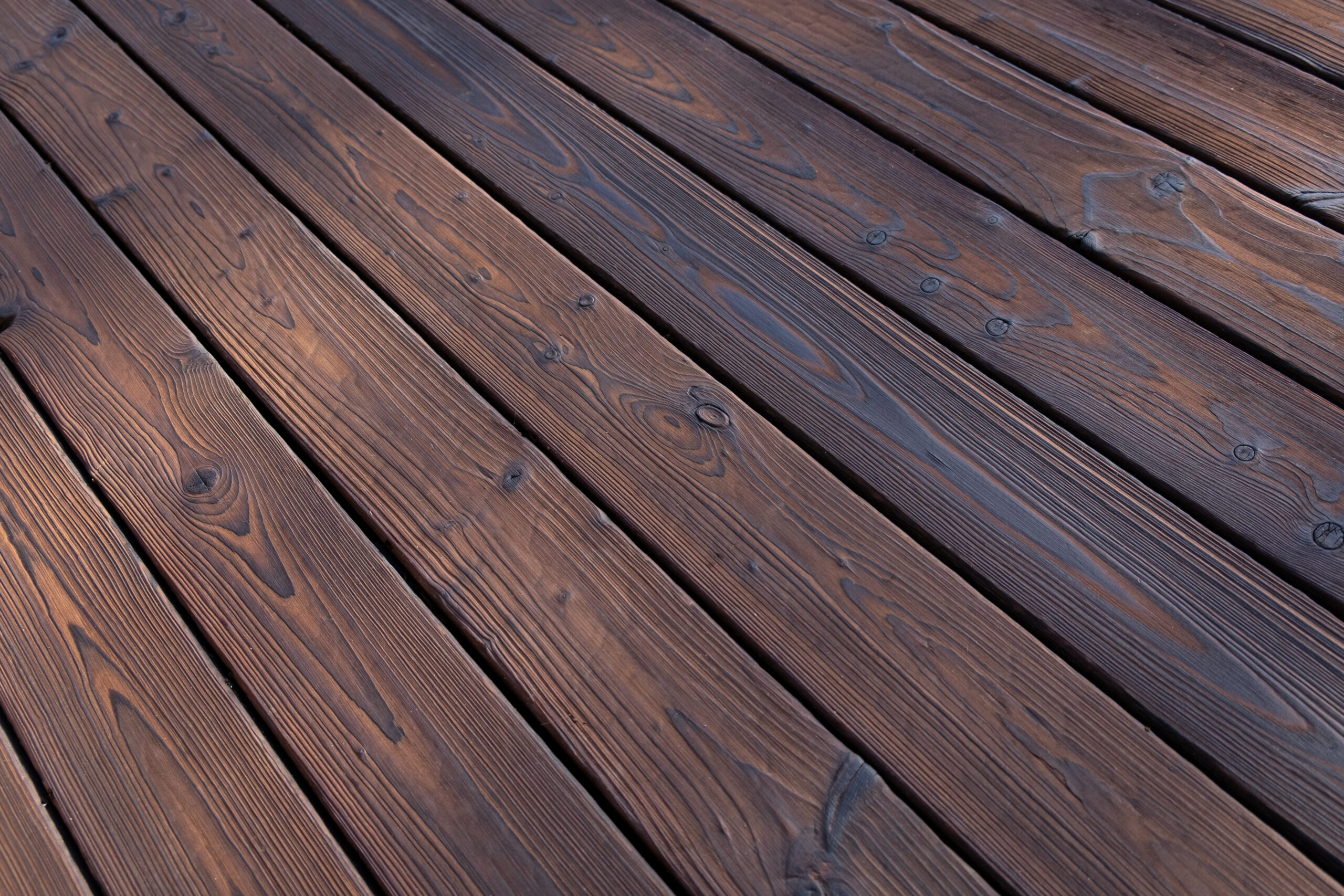
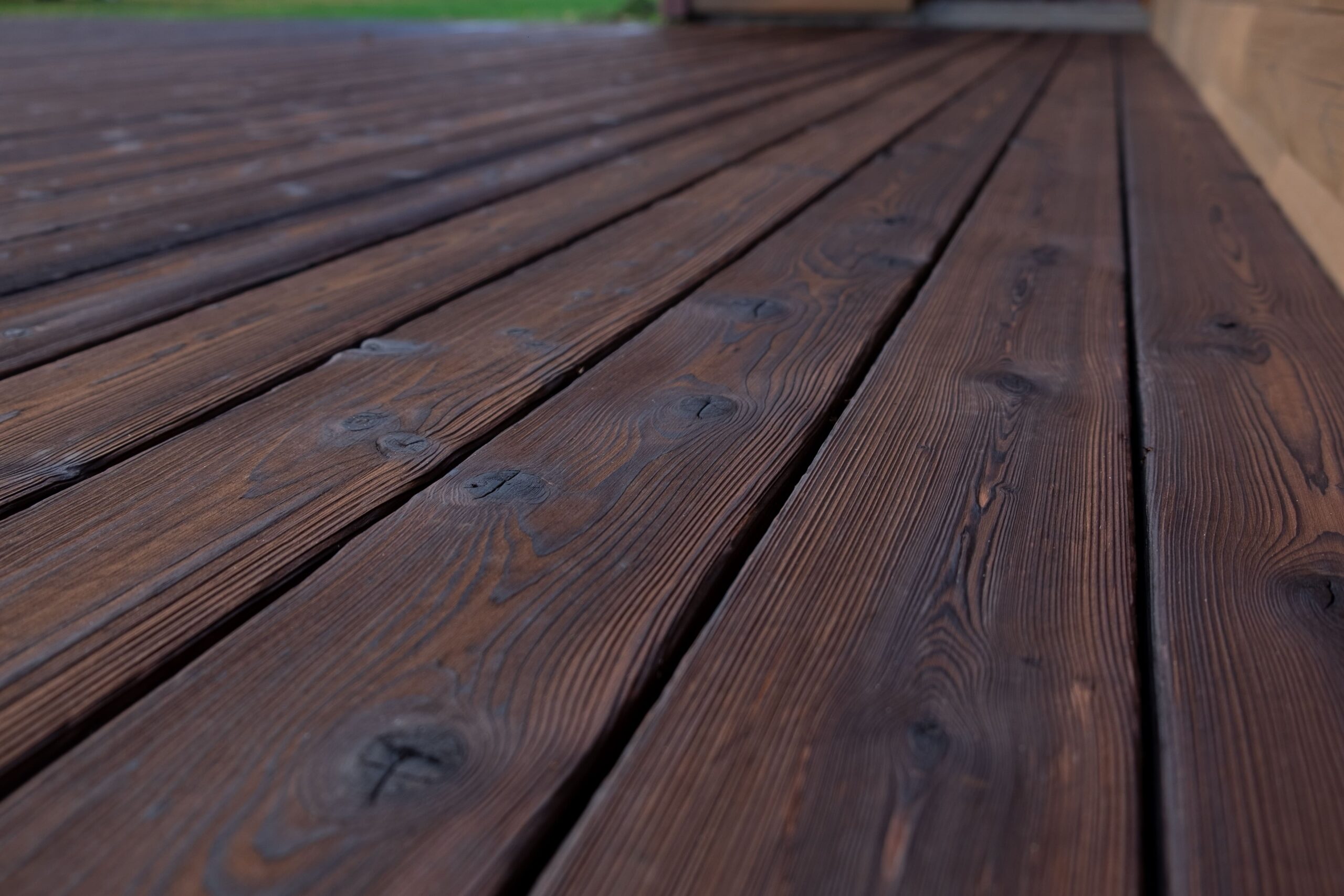
Charred wood for terraces offers more ways to choose the character of the surface. Charring and brushing can accentuate the grain, while the final finish helps create the desired shade. The result depends not only on the charring, but also on the wood species, the brushing and the oiling.
For a terrace, it is essential to choose charred boards prepared for walking on. A brittle char layer that suits a decorative wall is not equivalent to a decking surface. It is important to check that the finish does not crumble, that no loose char particles remain and how the surface is recommended to be maintained.
For terraces, Medeksa offers charred spruce and larch boards. When choosing between them, keep the original properties of the wood in mind: charring does not make spruce and larch equally hard. Charred spruce lets you get the finish you want on a smaller budget, while larch is the choice for those looking for denser wood.
Comparison of decking wood
The comparison helps you set priorities, but the final decision should be made after assessing the quality of the specific boards and the requirements for their use.
| Wood choice | Main advantage | Key trade-off |
|---|---|---|
| Impregnated pine | Usually a lower initial board price | Softer surface and continued wood movement |
| Larch | Denser wood and an expressive natural grain | Possible cracks, deformation and colour changes |
| Thermowood | Less swelling and shrinkage | Greater brittleness and important fastening requirements |
| Charred spruce | Accentuated texture and different finishing options | Wane may occur on the surface |
| Charred larch | A combination of denser wood and a charred surface | Like uncharred larch, it may crack, release resin in places and have wane |
Surface quality and comfort underfoot
Before ordering the whole terrace, it is worth inspecting board samples. A photograph does not show the roughness of the surface, the edge finishing or whether the finish rubs off easily. With charred wood it is especially important to assess the final preparation rather than judge by the dark colour alone.
A smooth surface does not in itself mean the terrace will be slippery, just as grooves do not guarantee safe footing once the boards are wet. Slipperiness is affected by moisture, algae and accumulated dirt. Terrace safety should therefore be linked to cleaning and water drainage, not just to the board profile.
Fasteners also matter for comfort. They must not protrude above the surface, and board edges and cuts must be neatly finished. These details are especially relevant where people often walk barefoot.
Terrace installation solutions and water drainage
Even high-quality boards will not make up for a poorly built structure. Beneath the terrace, air must be able to circulate and water must be able to drain away. The decking must not be planned so that the underside of the boards stays constantly damp or water is directed towards the building.
Board thickness has to be matched to the joist spacing and the expected loads. Supports spaced too far apart can cause the decking to flex, so universal dimensions should not be applied to all wood species and profiles.
The gaps between boards are not only there to let water escape. They also leave room for the wood’s dimensional changes. The exact gap depends on the product, the board width, the moisture content at the time of installation and the installation instructions.
Cut ends need attention too. Shortening boards exposes a previously unprotected surface, so its treatment has to be planned for during installation. The product used must be compatible with the chosen wood treatment and finish.
Terrace maintenance and surface renewal
Maintenance starts not with oiling but with cleanliness. Leaves, soil and other debris that collect between the boards prevent water from draining away. It is particularly worth checking under furniture and plant pots, where moisture can linger longer.
The need to renew the surface should be judged by its condition, not by the calendar alone. The most heavily walked areas may wear faster, while the covered part of the terrace changes more slowly. Oil or another maintenance product should be chosen according to the existing finish and its instructions for use.
Colour changes do not necessarily mean the wood has started to rot. However, loose fasteners, surface splinters or spots that stay wet for a long time are a reason to inspect not only the boards but the structure as well. When maintaining a terrace, both appearance and safe use should be considered.
The overall terrace budget
Wood prices are only worth comparing when you know what is included. Offers for boards of different thickness, profile or finish are not directly equivalent. Find out whether the product is ready to install or whether additional surface treatment will still be needed.
In the overall budget, include the substructure, ground preparation, fasteners, installation work and cutting waste. Over the longer term, maintenance costs matter as well. A lower initial board price does not always mean lower costs for building and using the terrace as a whole.
Choosing wood for your terrace
The right wood is easier to choose once it is clear where the terrace will be, how you will use it and which surface changes you consider acceptable. For one project the priority is a lower initial price, for another dimensional stability, and for a third an expressive texture and denser wood.
When choosing Medeksa charred wood boards, it is worth comparing spruce and larch samples, their texture and shades. To discuss your project, have the terrace dimensions, the planned board direction and information about the roof and the base ready. That way you can choose boards not just by the colour you like, but by the conditions in which they will be used.
Share
Find out how much a charred wood terrace would cost for your project